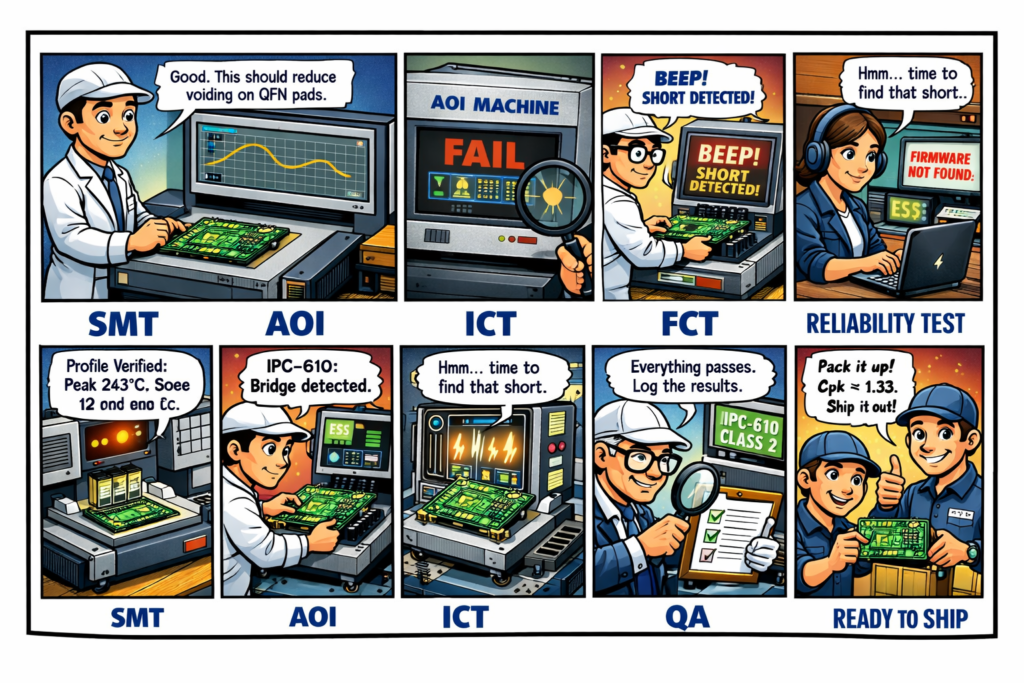
PCBA quality isn’t something you inspect at the end. It’s something you build into every step of the process.
1️⃣ SMT — Where Quality Begins Paste printing, SPI, stencil design, and reflow profile tuning determine most downstream stability. A stable profile (e.g., peak ~243 °C, soak ~120 s) helps reduce voiding on QFN pads.
2️⃣ AOI — Catching the Details AOI flags polarity errors, bridges, missing parts. We follow IPC‑A‑610 Class 2 criteria and fix issues immediately.
3️⃣ ICT — Electrical Integrity ICT verifies shorts, opens, component values, and pin integrity. It’s the fastest way to catch structural electrical issues.
4️⃣ FCT — Real‑World Functionality Power‑on, firmware load, communication tests (RS‑485, CAN, Ethernet). If it fails here, it’s usually design or firmware, not manufacturing.
5️⃣ Reliability Testing Temperature cycling (−40 °C to +85 °C), vibration, ESD, surge. Industrial products must survive real‑world stress.
6️⃣ QA & Traceability Visual inspection, firmware checksum, serial number logging. Traceability is essential for field returns and continuous improvement.
7️⃣ Continuous Improvement We track SPC and Cpk. If Cpk drops below 1.33, we stop and investigate.
Good PCBA quality is built, not inspected.
References: IPC‑A‑610, IPC‑7525, IPC‑7093, IEC 61000‑4‑2/4‑4/4‑5
#PCBA #ElectronicsManufacturing #SMT #FCT #QualityEngineering #OEM #ODM #HardwareEngineering #ReliabilityTesting #IPCStandards