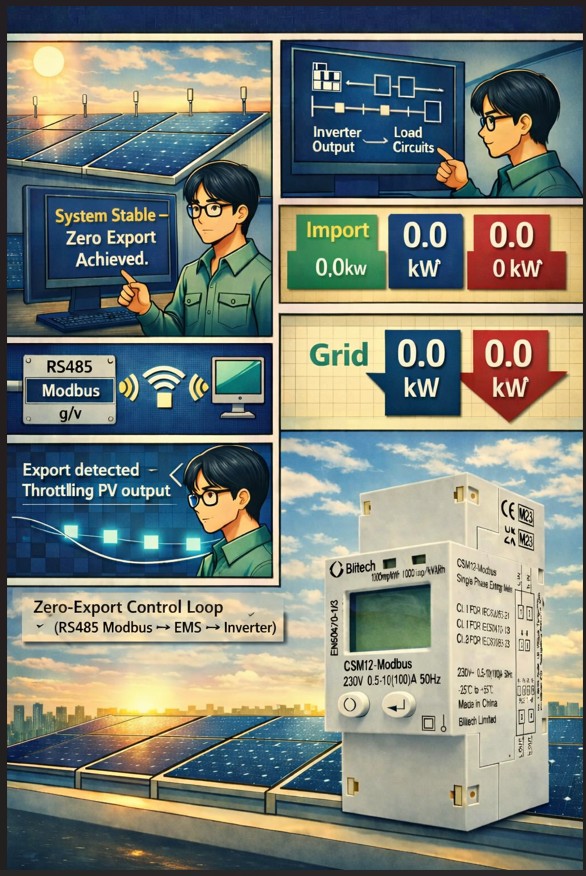
🔧 Hardening Zero‑Export Control: A Closed‑Loop Engineering Approach
Zero‑export compliance isn’t a configuration toggle — it’s a high‑frequency, dynamic control problem. When local load drops abruptly, the latency between grid‑edge measurement and inverter derating determines whether you stay compliant or trigger a reverse‑power relay.
Below is the exact control topology we use to maintain a true net‑zero steady state:
⚙️ Control Topology & Data Pipeline
Telemetry (Measurement): A CSM12‑Modbus power meter samples instantaneous active power Pgrid at the Point of Common Coupling (PCC) using high‑accuracy CTs.
Transport (Communication): Modbus RTU over RS485 operating at maximized baud rates to reduce polling‑cycle latency and prevent control‑loop degradation.
Computation (Decision): The EMS controller runs a dynamic feedback loop (typically PI/PID), computing the active‑power delta and generating the inverter power‑limit commands.
Actuation: Inverter registers are updated via broadcast commands, throttling PV output to match instantaneous load demand.
📉 Engineering Results
Steady‑State Stability: Net grid flow is actively regulated to 0.0 kW.
Transient Mitigation: Reverse‑power spikes during sudden load rejection are minimized in both duration and magnitude, meeting strict APAC and EMEA grid‑code requirements.
This deterministic closed‑loop architecture underpins utility‑approved zero‑export and anti‑reflux systems worldwide.
For peers working on EMS algorithm optimization, Modbus register mapping, or inverter OEM control integration, let’s connect and trade notes on loop performance.
📩 Donald Chiu — Blitech Limited Feel free to DM me or share how you optimize your control‑loop settling times.
#SolarEngineering #PVControl #ModbusRTU #EMS #InverterControl #SmartGrid #PowerElectronics #Blitech